
Between 2004 and 2006, archeologists undertook a major excavation of Chester’s Roman Amphitheatre.
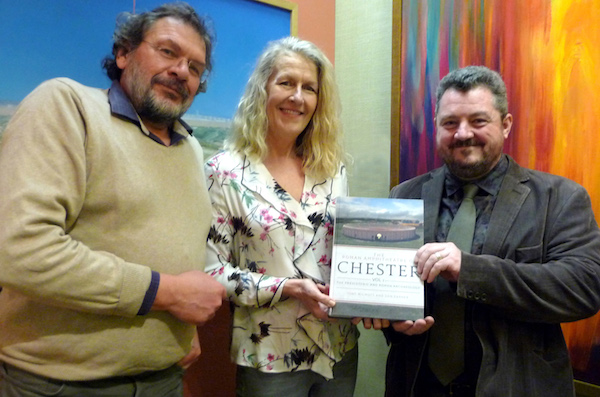
As a result of their work, a new book entitled ‘The Roman Amphitheatre of Chester Volume 1: The Prehistoric and Roman Archaeology’ was launched recently at Chester’s Grosvenor Museum.
The book details the research findings from the excavations – which were funded and managed by Historic England (then English Heritage) and the former Chester City Council.
The excavations revolutionised experts’ understanding of the scale and grandeur of Roman buildings in the city, and the activities that would have taken place in the arena and around the amphitheatre.
In addition to receiving interest from local residents and visitors to Chester at the time, the excavations also attracted national and international attention.
The BBC featured the excavations in the programme ‘Britain’s Lost Colosseum’.
Tony Willmot (senior archaeologist with Historic England) and Dan Garner (formerly of Chester City Council) are the co-authors of the recently-released first volume of the book.
It describes the elaborate structure of the amphitheatre and includes some remarkable reconstructions detailing how experts believe it almost certainly would have looked.
It also provides a fascinating study of early Roman occupation of Chester, and tells the story of the site from the around 6,000 BC to the end of the life of the Roman amphitheatre.
Cllr Louise Gittins, CWAC cabinet member for communities and wellbeing, said at the launch: “The project provided a fantastic opportunity for local volunteers and the wider community to get involved, they were able to gain experience of working on site and in finds processing, whether experienced or new to archaeology.
“The vast and complex task of analysing what was discovered over the course of those excavations has been carried out by Historic England, by our skilled and hugely knowledgeable archaeologists from Cheshire West and Chester Council and by specialists across the UK.
“This has all come together in this fantastic volume, which is a landmark moment for Chester, not only is it the definitive publication on the largest amphitheatre in Britain but it also puts prehistoric Chester on the map.”
‘The Roman Amphitheatre of Chester Volume 1: The Prehistoric and Roman Archaeology’ is available to purchase from the Grosvenor Museum.
The amphitheatre itself is a Scheduled Ancient Monument. The excavated area of the amphitheatre is owned by central government, whilst the unexcavated area of the amphitheatre is owned by Cheshire West and Chester Council.
English Heritage act as guardians for the part of the amphitheatre in government ownership, and it is managed by Cheshire West and Chester Council by agreement with English Heritage.
Historic England’s view is that excavations of the buried remains of the Roman amphitheatre in Chester – carried out between 2004 and 2006 – showed that only fragments of the amphitheatre survive as most of the stonework had previously been removed for re-use elsewhere.
The view of many experts is that it is highly unlikely further excavation would expose anything which can be displayed without a high level of reconstruction. Most of the walls on display today are 20th century reconstructions of what was once there.