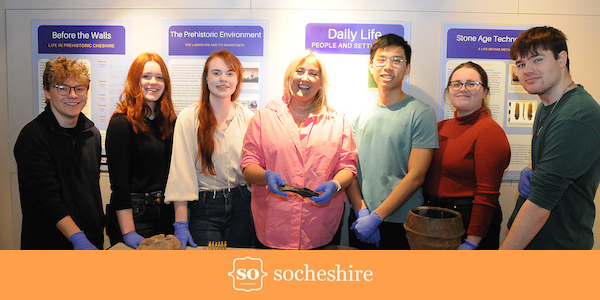
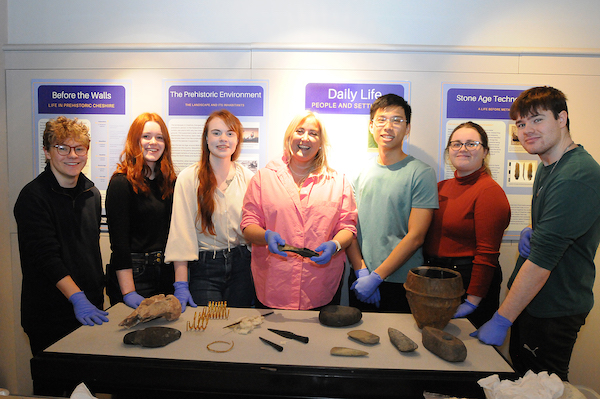
University students are bringing prehistoric Chester to life with an exhibition at the Grosvenor Museum that features rare tools and jewellery.
The exhibition, which is called Before the Walls – Life in Prehistoric Chester, runs until 30th April.
It’s been researched by third-year archaeology students at the University of Chester and is free of charge to visit.
It showcases the Grosvenor Museum’s significant collection alongside a series of interesting interpretation boards.
These summarise what the artefacts and wider archaeological evidence can tell us about life in prehistoric Chester and the surrounding area – including a highly worked flint found near the city’s amphitheatre.
Dr Caroline Pudney, senior lecturer in archaeology at the University of Chester, said: “Prehistory relates to the period from the end of the Ice Age to the Roman invasion – a huge span of time.
“Until you see the bones, it is hard to imagine that at one time Cheshire was home to woolly mammoths and aurochs (huge ancestors of modern cattle, often featured in cave paintings).
“This was the time of our Palaeolithic hunter-gatherer ancestors.
“It is extraordinary to think that anything survives from this time and yet close to Chester’s amphitheatre, a highly worked flint (the all-purpose Swiss Army penknife of its day) would have had multiple uses, including stripping animal hides.”
She added: “Having an opportunity to delve into the Grosvenor Museum’s collection, as well as loans from the Poulton Research Project, has been an invaluable experience and a privilege for the University’s archaeology students.”
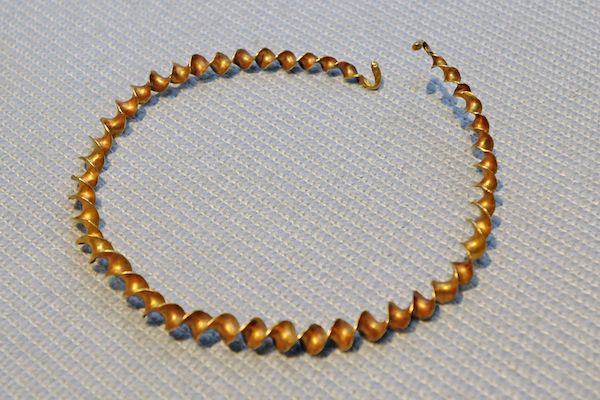
Highlights on display include an extraordinary Neolithic Jadeite axe-head and gold torc (necklace).
The Neolithic Jadeite axe-head (c. 4000 to c. 2,500 BCE) was found in Hunter Street.
Jade was quarried from blue-green stone only found high up in the Swiss Alps. Once polished, a Jadeite axe-head has a luminescent surface.
They’re desirable and precious objects, and are known to have had a symbolic significance, as wherever they are found (usually in a funeral setting) they appear to show no signs of use.
As well as Bronze Age flint arrowheads and bronze axes, the exhibition also showcases a small gold ‘ribbon’ torc.
Gold was an immensely revered and precious metal in the Bronze Age and the fusion of technical skill and design could only have been the work of a skilled and trusted craftsperson.
Cllr Louise Gittins, leader of Cheshire West and Chester Council, said: “I am immensely pleased that the Grosvenor Museum’s collection is being brought alive by these dedicated archaeology students with the support of the university and museum’s enthusiastic staff.
“Discoveries and research throw new light on the museum’s collection and we welcome our close, ongoing relationship with the University of Chester and its students as part of bringing these treasures to light.”
The Poulton Project
The Poulton Project is a multi-period rural excavation five miles south of Chester. Researchers have found extensive evidence for 10,000 years of human activity.
The site was discovered during the search for a lost Cistercian abbey, revealing the foundations of a medieval chapel and associated graveyard, with an estimated 2,000 burials.
Further research has also uncovered Mesolithic flints and later tools of Neolithic and Bronze Age farmers.
Notably, the site contains the largest Iron Age lowland settlement discovered in the North West.
An extensive and high-status Roman landscape is indicated by structures, industry and field boundaries, which have produced a large collection of ceramics, metal and building material.
The Grosvenor Museum
The Grosvenor Museum is located at 27 Grosvenor Street in Chester and was opened in 1886.
The Grade II listed building details the history of Chester – including its art, natural history and what life was like during the Roman military occupation.
It also contains a silver collection unrivalled outside of London.
The museum contains a Period House with rooms spanning from the 17th to the 20th century. It holds year-round exhibitions and events and also has an inspirational education service.
The University of Chester
The University of Chester is one of the oldest higher education institutions in the UK.
With links to heritage, museum and archive agencies within the city of Chester and beyond, the university’s Department of History and Archaeology is dedicated to providing the highest quality teaching and learning experience for its students as well as producing quality research and publications.
READ NEXT: